Inherited
TOGAF, ArchiMate, ITIL, COBIT, SAFe remain the foundations. TEAF doesn't replace them: TOGAF remains the methodological backbone, ArchiMate the reference notation.
The framework
A continuous loop, not a static document. TEAF is not a competitor to TOGAF, ITIL, COBIT or SAFe. It's a continuous orchestration layer on top of these frameworks — the engine that keeps them alive, with AI as an accelerator.
Philosophy & genesis
TEAF wasn't born in a research lab. It was born in steering committees, architecture reviews, and diagnostics of industrial organizations and financial firms trying to understand why their technical debt kept growing despite sustained investment. The pattern was always the same: executive committees fund transformation, IT departments deliver projects, and the gap between strategic intent and the reality of systems keeps widening — a gap generative AI accelerates more than it resolves.
The word "Temporal" in the name doesn't refer to scheduling or deadlines. It refers to continuity: an architecture that evolves with time and accumulated experience, rather than one frozen between periodic review cycles. This word choice has no connection to Temporal, the commercial software workflow orchestration platform — two independent uses of the same word.
Central thesis
"An organization stays governable as long as its governance speed matches its execution speed. Below that condition, architecture debt grows faster than the value produced."
This is TEAF's founding principle — a working hypothesis argued from repeated field experience, not a result empirically validated on comparative data. Book I details its foundations and invites the reader to judge it as such.
What TEAF contributes, precisely
TEAF doesn't claim eleven isolated terminological inventions. This distinction protects the framework's credibility with a demanding reader.
TOGAF, ArchiMate, ITIL, COBIT, SAFe remain the foundations. TEAF doesn't replace them: TOGAF remains the methodological backbone, ArchiMate the reference notation.
The Living ADR adapts the Architecture Decision Record practice (popularized by Michael Nygard, 2011) with a permanent link to the Knowledge Backbone. The Digital Twin, already widespread in engineering, is applied here to enterprise architecture.
Knowledge Graph, continuous governance and AI supervision exist separately elsewhere. No published framework brings them together in a single enterprise architecture system tied to named governance roles.
The closed eight-component Loop — Intent through Learning — and the five named governance roles that run it. No existing framework links these eight steps in a single, closed, end-to-end instrumented cycle.
How the loop works
From strategic intent to learning, every cycle closes the loop back to the next intent — without interruption, without re-entry.
The detail
The framework extends into eight operational patterns — AI Control Plane, Knowledge Backbone, Decision Fabric, Continuous Governance, Living ADR, Capability Graph, Digital Twin Loop, Architecture Intelligence Layer — detailed across the TEAF collection.
The strategic intent
The board's objective translated into actionable language, traced through to the decision.
The capability engaged
The business, technical or compliance capability engaged to serve an intent.
The available knowledge
Data, past decisions, dependencies and constraints — a single source of truth.
The architecture choice
The choice made from available knowledge, formalized as a Living ADR.
The automated execution
The automated execution of a decision, supervised by the AI Control Plane.
The change produced
The change actually produced in the information system.
The measured gap
The measurement of the gap between the outcome achieved and the original intent.
The learning
The learning drawn from observation, fed back into the next intent.
Cross-cutting foundations
They are not a stage of the program: they apply simultaneously to every component of the loop.
Zero Trust · IAM · GDPR · DR/BC plan
Architecture Review Board · Living ADR · Continuous Governance
Knowledge Backbone · Data Mesh · Vector DB · RAG
SRE · SLI/SLO · Prometheus · Grafana
Control · Resilience · Hybrid cloud
GDPR · EU AI Act · Audit · Tax
Deployment
Each phase produces concrete deliverables before the next one is engaged. No total, simultaneous overhaul of the information system.
Maturity model
Honestly positioning the starting point conditions everything else. The online diagnostic places your organization in six minutes.
No reliable overview. Every decision starts from zero; knowledge lives in a handful of people's heads.
Diagrams and doctrine exist on paper but don't drive real decisions.
Mapping and decisions are documented and kept up to date, but execution remains largely manual.
Decisions are tracked (ADR), deployments are tooled, first indicators are monitored.
Knowledge, decisions and execution are linked in a single system. Gaps are measured systematically.
The intent → execution → observation → learning loop runs continuously, with governance built in.
AI orchestrates most of the cycle under human supervision. The organization learns from every decision in near real time.
Guiding principles
Every architecture action starts from a formalized intent, traceable back to the board.
An architecture decision is a flow, not a milestone: it is re-evaluated with every relevant new piece of information.
Every technical component links to a documented decision, itself linked to an original intent.
One living source of truth — the Knowledge Backbone — replaces parallel documentation.
No agent, no pipeline, deploys a critical change without passing through the Decision Fabric.
Observation and learning systematically close the cycle back to the next intent.
Compliance is assessed continuously, not through point-in-time audits.
The level of detail required adapts to the criticality of the capability, not a uniform standard.
TEAF integrates with TOGAF, ITIL or COBIT without replacing them: it orchestrates their continuous execution.
The complexity shown to a leader always stays below the real complexity of the system.
Explore TEAF through theory
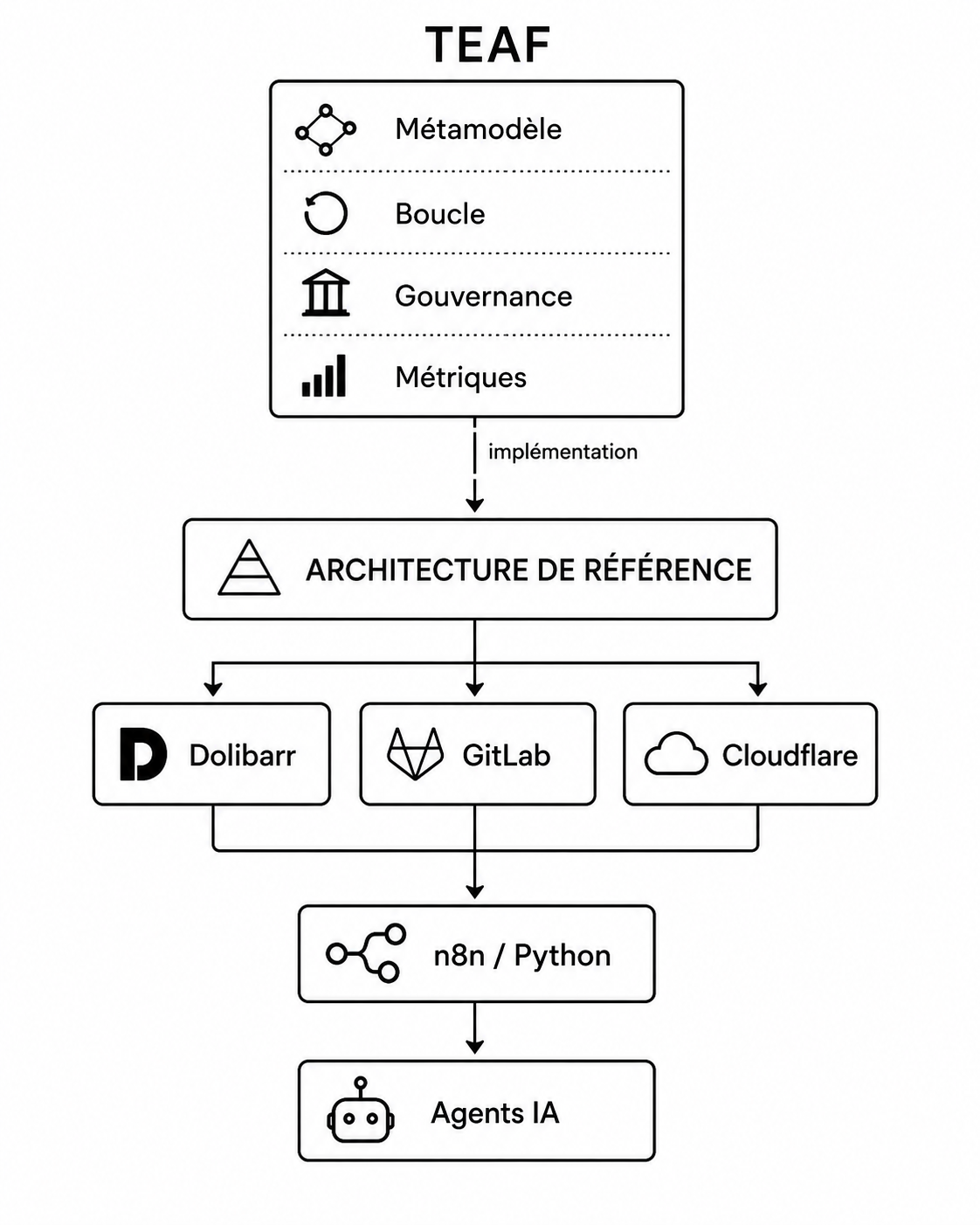
The four books forming the complete corpus: the Manifesto (thesis and vocabulary, for COMEX and CIOs), the Framework Specification (metamodel, artifacts, roles, for architects), the Practitioner's Guide (deployment, playbooks, for consultants and ops teams) and the Operational Implementation Guide (the 1-1-1 principle, scoping a POC, deployment trajectories). V1 of the collection, now complete — a V2 is planned, enriched with constructive feedback from other organizations, with no release date announced. Available in paperback and Kindle.
Explore TEAF hands-on
The executable implementation of the 1-1-1 principle detailed in Book IV — one process, one loop, one measurable objective — and a reference stack (Dolibarr, GitLab, PostgreSQL/pgvector, n8n, Python, Cloudflare) to start on a limited scope in a few weeks. Free and open source, unlike the book that documents it; can also serve as a POC before committing to the full collection.
| TEAF Full | TEAF Light | |
|---|---|---|
| Content | 4 books: Manifesto, Specification, Practitioner's Guide, Operational Implementation Guide | Open source reference implementation, executable companion to Book IV |
| Goal | Understand the full theory, train roles, the Architecture Review Board | Start execution on a limited scope |
| Principle | 8-component loop, 10 principles, 9 anti-patterns | 1-1-1 principle: one process, one loop, one measurable objective |
| Starting point | Reading, strategic framing | POC in a few weeks |
| Access | Amazon, paperback and Kindle | GitLab, open source license |
Take the diagnostic or explore the role-based certification program.