The collection
The TEAF collection
The four books that formalize the method, from the strategic manifesto to operational implementation — V1 of the collection, now complete. All available on Amazon, in paperback and Kindle; Books I to III also as a 3-book series — see the series.
01
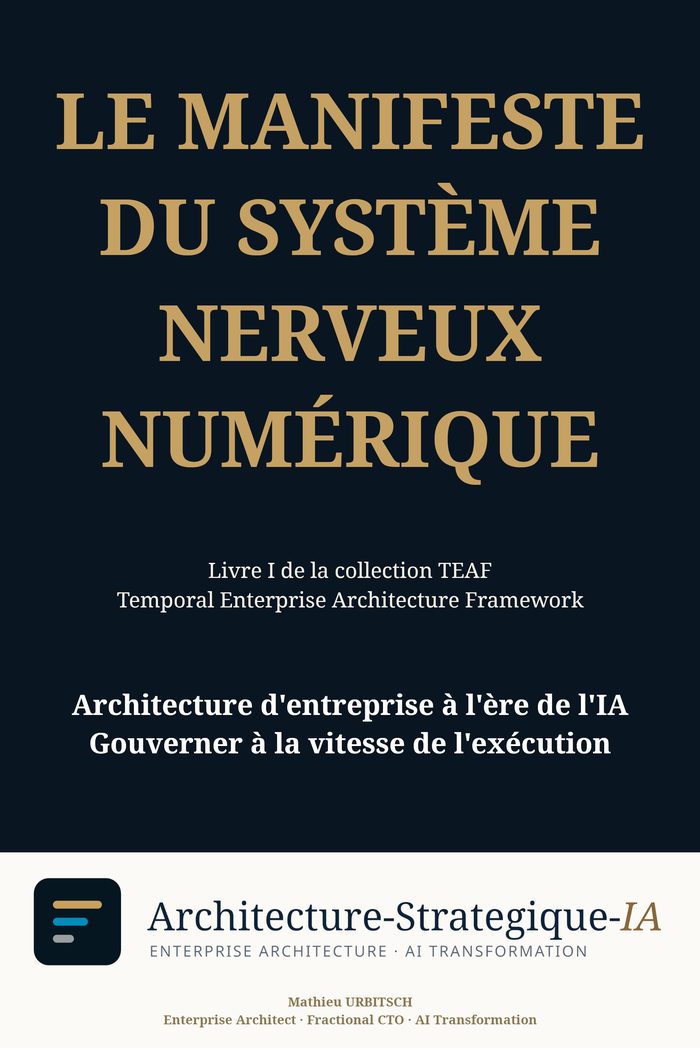
TEAF — Book I: The Digital Nervous System Manifesto
The thesis and the vocabulary: why enterprise architecture stops being a document and becomes a living system. For boards, CIOs, CEOs, CTOs.
- Five axioms and five laws on the pace of governance
- Nine enterprise architecture anti-patterns
- The seven-level maturity pyramid
Born from the same pattern seen mission after mission: boards fund transformation, CIOs deliver projects, and the gap between intent and the reality of systems keeps widening. A dedicated section precisely distinguishes what TEAF inherits from TOGAF, ITIL, COBIT and SAFe, what it adapts, combines, and what remains unique to it.
02
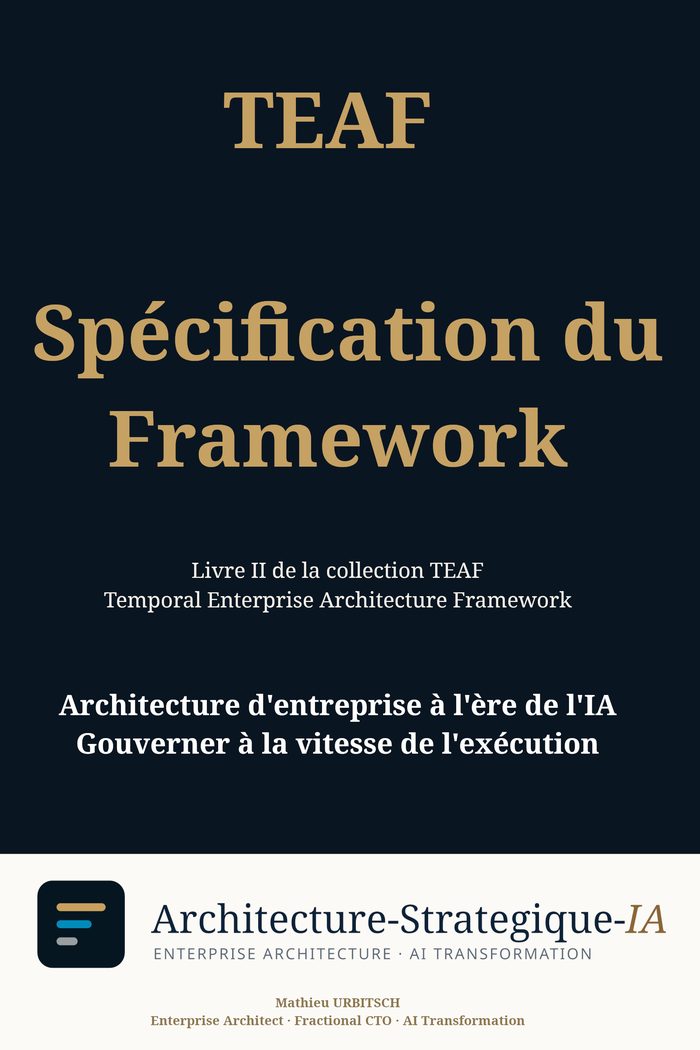
TEAF — Book II: Framework Specification
The complete technical specification for architects: the eight-component metamodel, artifacts, patterns and anti-patterns, governance.
- The metamodel and its eight components, in detail
- The artifacts: Living ADR, Knowledge Graph, Digital Twin, Capability Map
- Eight patterns, nine anti-patterns, the five TEAF roles
Also contains the terminology reference for TEAF's eleven structuring vocabulary terms — whose fixed definitions the site's knowledge base reuses — as well as the five founding axioms and the five laws of AI-native architecture.
03
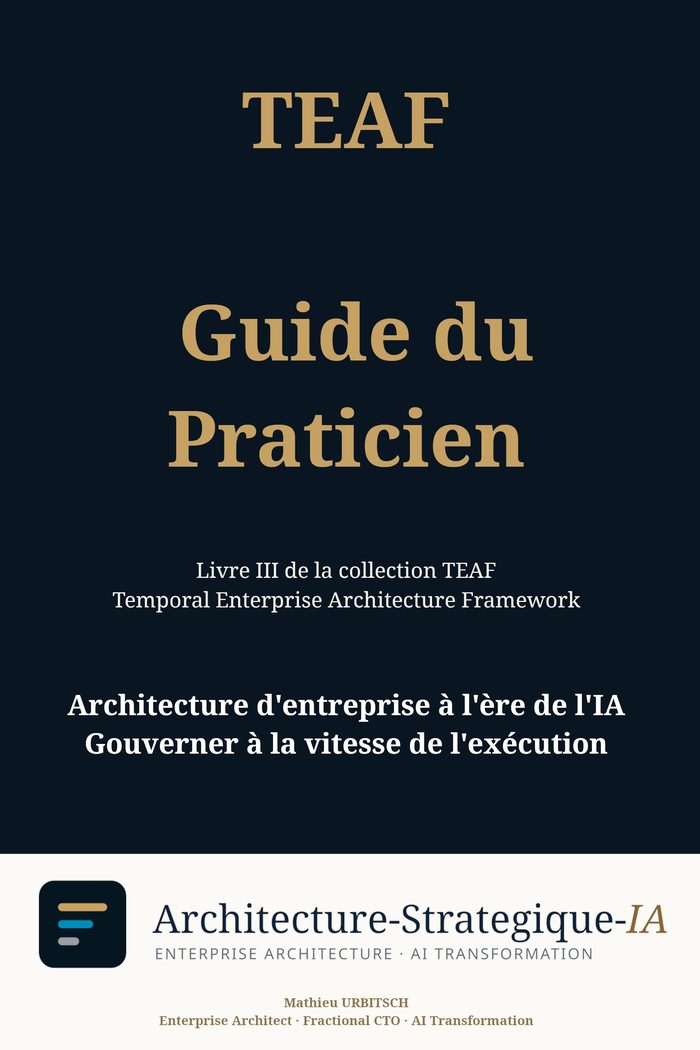
TEAF — Book III: The Practitioner's Guide
Concrete deployment, mission after mission: the four operational phases, playbooks and case studies. For consultants and ops teams.
- The four-phase method: Why / What / How / Who-When
- Playbooks for recurring situations (architecture review, migration, security, FinOps)
- Five fictional scenarios to illustrate the method
Its Part IV provides directly actionable checklists — NIS2/AI Act/GDPR compliance audit, security, human-in-the-loop, data provenance — reused in interactive form on the site's Diagnostic page.
04
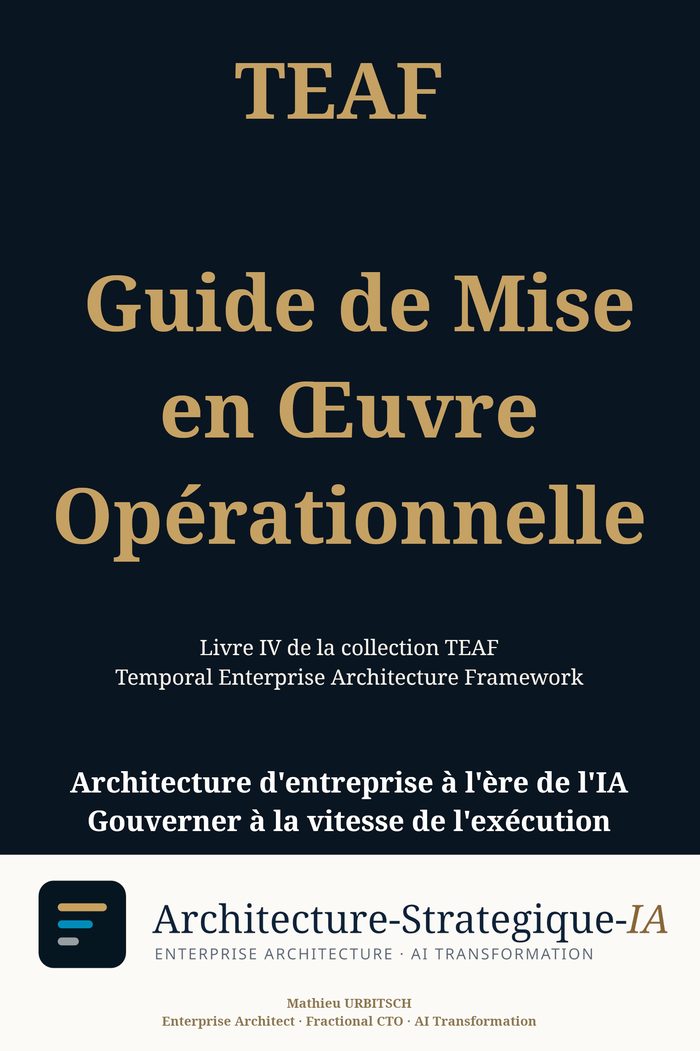
TEAF — Book IV: Operational Implementation Guide
The practical guide for experimenting with and deploying TEAF in a real environment: scoping a POC, starting with TEAF Light, extending progressively. For executives, CIOs, architects and consultants.
- The 1-1-1 principle applied step by step: scoping a POC, its objectives and success criteria
- The progressive rollout of the Loop's eight components, without a new documentation layer
- Adoption trajectories, from POC to broader deployment, for SMBs, mid-size and large organizations
Its pedagogical throughline — intelligent invoice processing — illustrates a complete end-to-end TEAF Loop; like the scenarios in Book III, it is explicitly presented as a fictional construction, not a real engagement outcome.